Disclosure: This post contains affiliate links. If you buy through them, I may earn a small commission at no extra cost to you. I only recommend gear I'd actually trust on my own trips. Disclaimer | Inewfinds.com
I bought my first portable power station after a summer storm knocked out my power for two days and I watched the food in my fridge slowly give up. That same unit ended up coming camping with me three weeks later.
And that's the thing about a good power station — it lives a double life. Half the year it's an emergency backup sitting quietly in a closet, and the other half it's running your lights, your phone, and maybe a little camp coffee maker out in the middle of nowhere.
The tricky part is choosing one. The market is crowded, the spec sheets all blur together, and once you start adding up batteries and solar panels, the price climbs fast. So I narrowed it down to three units that hit the sweet spot for most people: reliable, genuinely portable, capable of handling both camping trips and household backup, and all priced under $1,000.
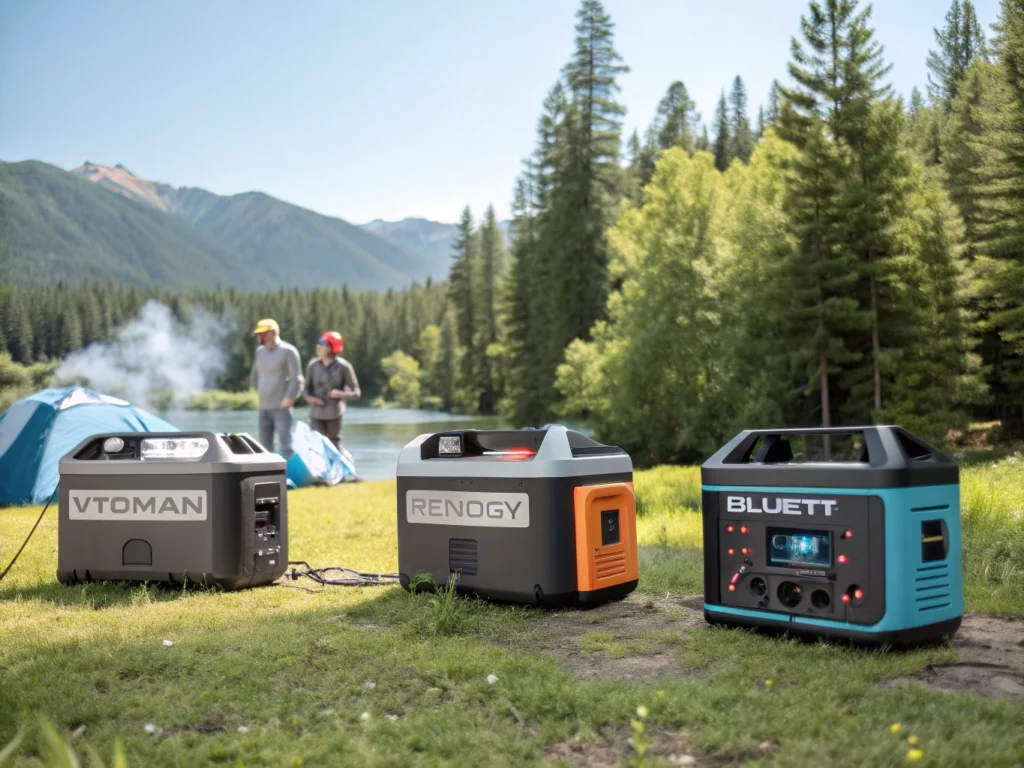
Those three are the VTOMAN FlashSpeed 1000, the Renogy Phoenix 1000, and the Bluetti AC180. Below I'll break down how they stack up, who each one is really for, and which I'd pick depending on what you actually need.
Quick verdict: my top picks at a glance
If you're in a hurry, here's the short version.
The most power (1,800W) and the biggest battery of the three, usually at the lowest price. Hard to beat for the money.
Check the latest price →Rugged, expandable, and it can even jump-start your car.
Check the latest price →Its iBoost mode handles power-hungry gear other 1,000W units choke on.
Check the latest price →IMAGE SPOT — add a photo here. Alt text: "Portable power station for camping and home backup under $1000"
Side-by-side comparison
Here's how the three measure up on the specs that matter most.
| Feature | VTOMAN FlashSpeed 1000 | Renogy Phoenix 1000 | Bluetti AC180 |
|---|---|---|---|
| Battery capacity | 828Wh | ~998Wh | 1,152Wh |
| Rated output | 1,000W (2,000W surge) | 1,500W (iBoost up to 3,000W) | 1,800W (2,700W power lifting) |
| Battery type | LiFePO4 | LiFePO4 | LiFePO4 |
| Expandable? | Yes — up to ~2,376Wh | No | No |
| AC charge speed | ~70 min (0–100%) | ~1 hr to 80% | ~45 min to 80% |
| Solar input | Up to 300W | Up to ~400W | Up to 500W |
| Standout feature | Built-in car jump starter | iBoost for big appliances | Fastest charging + most power |
| Weight | ~37 lbs | ~26 lbs | ~35 lbs |
| Typical price | $499–$649 | $799–$999 | $419–$499 |
| Best for | Off-grid camping, expandability | Running larger appliances | Best all-around value |
Prices shift constantly with sales, so tap any "Check price" link to see the current number.
What to look for in a portable power station
Before the deep dive, it helps to know what these numbers actually mean in real life. If you only skim one section, make it this one — it'll save you from overbuying or underbuying.
Battery capacity (watt-hours / Wh)
This is your fuel tank. A 1,000Wh battery can, roughly, run a 100W device for about 10 hours. More Wh means longer runtime, but also more weight and a higher price. For a weekend of camping or a day or two of essential backup, anywhere from 800Wh to 1,200Wh is the comfortable zone — exactly where all three of these units sit.
Rated output (watts / W)
This is how much power you can pull at once. Your battery size decides how long; the output decides what you can run at all. A 1,000W unit happily powers phones, laptops, lights, fans, a CPAP machine, and a mini-fridge. Push past that — a microwave, a kettle, a hair dryer, a space heater — and you need 1,500W or more. This is the single biggest difference between the three units here, so think hard about what you actually plan to plug in.
Battery chemistry
All three use LiFePO4 (lithium iron phosphate), and that's exactly what you want. These batteries last roughly 3,000+ charge cycles — often three to four times longer than the older lithium-ion cells in cheaper units — and they handle heat better. Buy a LiFePO4 station and it'll likely outlast the phone you're charging with it by a decade.
Charging speed
How fast it refills from a wall outlet matters more than people expect, especially for emergencies. If a storm is coming, you want to top off quickly. Solar input matters for off-grid trips, where it's your only way to refuel.
Ports and portability
Count the outlets you'll actually use — AC plugs, USB-C, USB-A, a car port. And be honest about weight. "Portable" still means 25 to 40 pounds for this class. None of these will feel light after a long carry from the car to the campsite.
VTOMAN FlashSpeed 1000 review: the rugged, expandable workhorse
IMAGE SPOT — add a photo here. Alt text: "VTOMAN FlashSpeed 1000 portable power station ports and display"
The VTOMAN FlashSpeed 1000 feels built to take a beating. The casing is chunky, the handles are molded right into the body, and there's a smart little storage compartment up top for stashing your cables so they don't end up tangled in the bottom of your trunk. It's the kind of design that tells you VTOMAN expected this thing to live in the back of a truck, not on a desk.
Under the hood you get an 828Wh LiFePO4 battery and 1,000W of continuous output (2,000W surge). That's enough for the everyday stuff — charging laptops and phones, running camp lights, keeping a small cooler or CPAP going overnight. It's not the unit you'd pick for a microwave, but for most campers that's not the point.
Two features set it apart. First, it's expandable — add VTOMAN's extra battery and you climb to around 2,376Wh, which is genuinely a lot of runtime for extended off-grid stays. Second, it has a built-in car jump starter, which is one of those features you forget about until the morning your car won't start at the trailhead, and then it's the best $500 you ever spent. It also charges from empty to full in about 70 minutes from a wall outlet, and there's a big LED light panel on the back with an SOS mode.
The main trade-off is weight. At around 37 pounds it's the heaviest of the three relative to its capacity, and it's not weatherproof, so keep it out of the rain.
- Tough, well-built design made for the outdoors
- Expandable up to ~2,376Wh for long trips
- Built-in jump starter and bright LED light
- Fast ~70-minute full recharge
- Lowest capacity and output of the three
- On the heavy side for its size
- Not weatherproof
Who it's for: Campers and overlanders who want a rugged unit they can grow into, and anyone who likes the peace of mind of an onboard jump starter.
Rugged, expandable to ~2,376Wh, with a built-in jump starter.
Check the latest price & availability →Renogy Phoenix 1000 review: the one that runs the big stuff
IMAGE SPOT — add a photo here. Alt text: "Renogy Phoenix 1000 power station running a household appliance during an outage"
Renogy made its name in solar gear, so it's no surprise the Phoenix 1000 plays nicely off-grid. But the headline feature here is power delivery. With a 1,500W rated output and Renogy's iBoost mode, this unit can run appliances rated up to 3,000W by intelligently throttling the draw so it doesn't overload. In practical terms, that means it'll handle gear that makes a standard 1,000W station trip and shut off — think a full-size fridge, certain power tools, or a coffee maker.
The roughly 998Wh LiFePO4 battery is good for 2,000-plus cycles, and you get a generous twelve outlets including six AC sockets — handy when the whole family is trying to charge at once during an outage. It refills to 80% in about an hour from the wall, and it pairs cleanly with Renogy's own solar panels if you want to go fully off-grid.
It's also the lightest of the three at around 26 pounds, which makes the camping-to-car shuffle a little less of a workout. The catch is price: the Phoenix 1000 usually sits at the top of this group's range, and unlike the VTOMAN it isn't expandable, so what you buy is what you get.
- iBoost mode runs appliances up to 3,000W
- Most AC outlets (six) — great for households
- Lightest unit here at ~26 lbs
- Strong solar ecosystem from a trusted solar brand
- Usually the most expensive of the three
- Not expandable
- Slightly smaller battery than the Bluetti
Who it's for: Anyone whose main worry is running larger or higher-wattage appliances, and households that want plenty of outlets during an outage.
iBoost mode handles gear up to 3,000W, with six AC outlets.
Check the latest price & availability →Bluetti AC180 review: the best all-around value
IMAGE SPOT — add a photo here. Alt text: "Bluetti AC180 portable power station charging multiple devices"
If you forced me to hand one of these to a friend who didn't want to overthink it, it'd be the Bluetti AC180. It quietly wins on the two numbers that matter most — capacity and output — and it usually does it at the lowest price in this group, which is why it keeps showing up on bestseller lists.
You get a 1,152Wh LiFePO4 battery (the biggest here) and a full 1,800W of output, with a 2,700W "power lifting" mode for short bursts. That combination means it'll run a surprising amount of household gear, comfortably handle a long camping weekend, and not blink at the everyday electronics most people actually use. The LiFePO4 cells are rated for around 3,500 cycles, so this is a buy-once-and-forget-it kind of unit.
It also charges fast — roughly 0 to 80% in about 45 minutes from the wall, the quickest of the three. That's a real advantage when you're racing an incoming storm or just want it topped off before you leave. Solar input goes up to 500W, the highest here, so it refuels well off-grid too.
The main limitation is that, like the Renogy, it isn't expandable — though with the largest battery of the bunch, most people won't feel the need. At around 35 pounds it's middle-of-the-pack on weight.
- Largest battery (1,152Wh) and highest output (1,800W)
- Usually the lowest price — excellent value
- Fastest charging (~45 min to 80%)
- Highest solar input at 500W
- Not expandable
- No standout extra like a jump starter
- Still a 35-pound carry
Who it's for: Honestly, most people. If you want the most capability per dollar and don't need a specific gimmick, this is the safe, smart pick.
The biggest battery and highest output here, usually at the lowest price.
Check the latest price & availability →Camping vs. home backup: which wins for each job?
These units overlap a lot, but if your use leans heavily one way, here's how I'd think about it.
For camping and off-grid trips, weight, solar charging, and durability matter most. The VTOMAN is the rugged specialist — expandable for long trips and useful for vehicle emergencies on rough roads. But the Bluetti AC180 is the better all-rounder even here, thanks to its bigger battery and stronger solar input, which means longer runtime between charges when the sun is your only outlet.
For home backup, what you care about is running real appliances and having enough outlets for everyone. The Renogy Phoenix 1000 shines here with its iBoost mode and six AC sockets — it'll keep a fridge and several devices going during an outage. The Bluetti is a close second, with more raw output than the VTOMAN and the fastest recharge so you can top it back up the moment power flickers back.
So which one should you buy?
Let me make it simple.
Buy the Bluetti AC180 if you want the best value and the most capability without overthinking it. It's the one I recommend to most people.
Buy the VTOMAN FlashSpeed 1000 if you camp often, want room to expand later, or like the security of a built-in jump starter.
Buy the Renogy Phoenix 1000 if your priority is running larger appliances and having plenty of outlets during a power outage.
All three are LiFePO4 units that'll last for years, so there's no wrong answer here — just a best match for how you plan to use it.
Frequently asked questions
Can a portable power station run my refrigerator?
Yes, most full-size fridges run on 100–800W, well within the range of all three units. The Renogy Phoenix 1000 and Bluetti AC180 have the most headroom for the startup surge a compressor draws. On battery alone, expect to keep a fridge cold for several hours to most of a day, depending on the model.
Are these safe to use indoors?
Completely. Unlike gas generators, battery power stations produce no fumes or carbon monoxide, so they're safe to run inside your home, tent, or RV. That's a big part of why they've become so popular for backup power.
How long will a power station last during an outage?
It depends on what you're running. A ~1,000Wh unit can keep phones, a router, lights, and a fridge going for a day or so if you're careful. Add a solar panel and you can stretch that indefinitely in good weather.
What does LiFePO4 mean, and why does it matter?
LiFePO4 (lithium iron phosphate) is a battery chemistry that lasts far longer and runs cooler and safer than the older lithium-ion cells in budget units. All three stations here use it, which is exactly what you want for a long-term investment.
Can I charge these with solar panels?
Yes — all three accept solar input. The Bluetti AC180 takes the most (up to 500W), making it the quickest to recharge off-grid, but each pairs with compatible portable panels for true off-grid use.
Which is the best value overall?
The Bluetti AC180 typically offers the most capacity and output for the lowest price, which is why it's the value pick in this comparison.
Final thoughts
A good portable power station is one of those rare purchases that pulls double duty — quiet insurance for the next outage and a ticket to comfortable, off-grid weekends. Any of these three will serve you well for years thanks to their long-lasting LiFePO4 batteries.
If you want my one-line recommendation: get the Bluetti AC180 unless you have a specific reason to choose otherwise — namely, expandability and a jump starter (go VTOMAN) or running bigger appliances (go Renogy).
Whichever you choose, tap through to check the current price before you buy — these go on sale often, and a few minutes of timing can save you real money.
Rugged and expandable, with a jump starter.
Check today's price →iBoost power delivery and plenty of outlets.
Check today's price →